
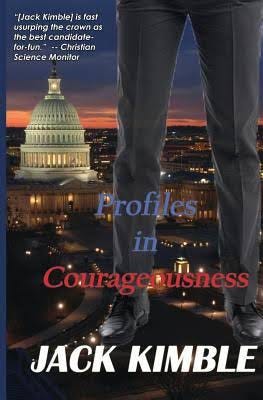
Profiles in Courageousness
Part One of an Excerpt from my 2012 novel.

{I thought I would do something a little different and serialize part of my 2012 novel Profiles in Courageousness. I haven’t really promoted this book because I published it through a company and I really do need to do a second edition of it and self-publish. However, I thought you might enjoy this brief glimpse of how I became the man I am today.]
It was the Corn Dog Festival in Hampton, in August, 2005, and the town’s gray dilapidated water tower rose above the pastoral landscape looming like Olympus above the House of Spaghetti. I breathed in a summer bouquet of corn dogs, elephant ears, and hard working Joes and Janes. The corn dog is the most Republican of foods. You take something delicious like a hot dog, but then you make it better by frying it and you put it on a stick so you can eat it while you work. That’s why corn dogs sell so well in red states like Texas.
As I walked through the park, I could breathe in the fragrant bouquet that the great melting pot of the Golden State was cooking up on that afternoon. Foot-long hot dogs and cotton candy. Nachos and egg rolls. The toothless banjo players on the rugged wooden stage and the carnies—always the carnies, those descendants of the cowboys of the old West finding their manifest destiny hitched to the back of an old truck with a 30 year old Tilt-a-Whirl.
Inching through rivers of people like a salmon drawn to spawning grounds, I saw young, carefree teenagers and a young couple holding a small homely baby. There were many older folks who had seen Hampton go from a small town of 3,800 in 1970 to its current size of nearly 14,500 today. These were good, honest folk, the kind that America had been built on.
“Hey Jack! You sure love a good corn dog.”
“Oh wow Jack! You sure are ruggedly good looking in a suave and sophisticated way.”
“When are you going to get into politics Jack? Isn’t it time you gave something back to the state?”
The sun was beginning to really beat down, and I wiped the sweat from my brow thinking back to the long days on the family’s olive farm when the heat of the sun could turn your skin to leather. As I wound my way through the crowd, a high school dance troupe took the stage, and the music began to blare, much to the chagrin to the crowd of seniors who had been enjoying the banjo music. I stopped by the Right to Life booth where they were selling homemade, fetus shaped, butter cookies. I plunked down a dollar, and took one of the cookies. As I ate it, I thought of how precious human life really is.
It also reminded me of how impatient I was with politics. I was so tired of politicians raising my taxes to pump up social programs for the people of California when there were so many people who were never born. Why wasn’t anybody doing anything for them? Politics were tricky. I was connected enough with grass roots conservatives that they all asked me when I was going to run for office, but I wasn’t connected enough with the state Republican Party that they’d ever endorse me for congress in the 54th District.
A friendly volunteer from the Robert Engle Society poked his head out of his booth and beckoned over to me. It had been over 40 years since my father had been one of the 12 founders of the group that helped lead the fight against world wide communism, fluoridation of drinking water, the infiltration of the civil rights movement by our country’s enemies, the domestication of cats, and the United Nations. I had hated the way that political machines and their pals in the media had distorted things to make the group seem irrational. I admired the brave volunteers who manned the booth knowing the jeering and heckling they would endure from liberal hippies who protested the society’s goal of trying Bill Clinton for war crimes. If men like these were crackpots because they wore tinfoil underneath their baseball caps or bottled their own urine, then maybe we were all crackpots.
I couldn’t help wonder if I was a little nuts for opening myself up to the same kind of criticism my dad had. A run for public office would be difficult, and not all my views were popular with the liberal elite. My father could have easily ignored the dangers of an emerging new world order and lived a happy and prosperous lifestyle. His great-grandfather’s invention of the Kimble Olive Pitter and our land holdings had made the Kimbles very wealthy. However, the Kimbles had always been brought up on the grand tradition of service to others.
It seemed that real public service, crafting policies that were good for business, had been derailed by politics and its infernal machines. I wanted to help people, and I had an interest in government. It was an interest that had first been awakened as a teenager by watching Ronald Reagan and the way he had stopped the Air Traffic Controllers from striking and had brought democracy to Central America. Pursuing public service is what had brought me to Indiana to study at Notre Dame where I received both my BA and MBA.
Most people starting out in politics have to start at the bottom. I was lucky because with my father’s connections and financial support, I knew that the United States Congress could be within my reach. California’s 54th District is rather unusual in that it has a small Hispanic voting population, but the majority of the district is white, wealthy, and over 60. They had been served in the House by Jerry “Hoop” Hooper for a dozen years and like most of the district he was older, white, and wealthy. He also wasn’t terribly influential in the House. In a Republican district, he seemed to have no trouble voting with the Democrats. I knew I could beat this guy.
And so, on that hot August night, I took the stage before an America cover band called Ventura Highway performed. I faced the electorate, looked them square in the eye, and I let them know that I would be running for Congress and needed their support. A whole lot of things could have happened, and most of them were bad. Then I saw a young woman who couldn’t have been more than 25 years old in a white floppy hat. She tucked her corndog in the crook of her arm and began clapping. Then, like a polio outbreak, the applause began to spread through the entire crowd.
I began to stop and smile at the audience, and they returned my enthusiasm. As the band behind me began to play the opening chords of “Sister Golden Hair,” I felt like I was a rock star. I had committed to the race and there was no backing out now. I had developed a strategy that I thought would win in this district, but I needed to implement it well.
.
The line of contempating the value of life while eating the fetus cookie brought a tear to my eye, probably because I was laughing so hard. The imagery reminds me so strongly of county fairs of my Indiana childhood right down to the John Birch Society booth.
If you republish, I'd like li,e to be first in line to buy a copy.
I always wondered who was behind the domestication of cats. Interesting.